





 Vietnamese
 中文
中文
 日本語
日本語
 한국어
한국어
 Français
 Русский
 Deutsch
 Español
 Bahasa Indonesia
 ไทย
ไทย
 ພາສາລາວ
 ខ្មែរ
ខ្មែរ


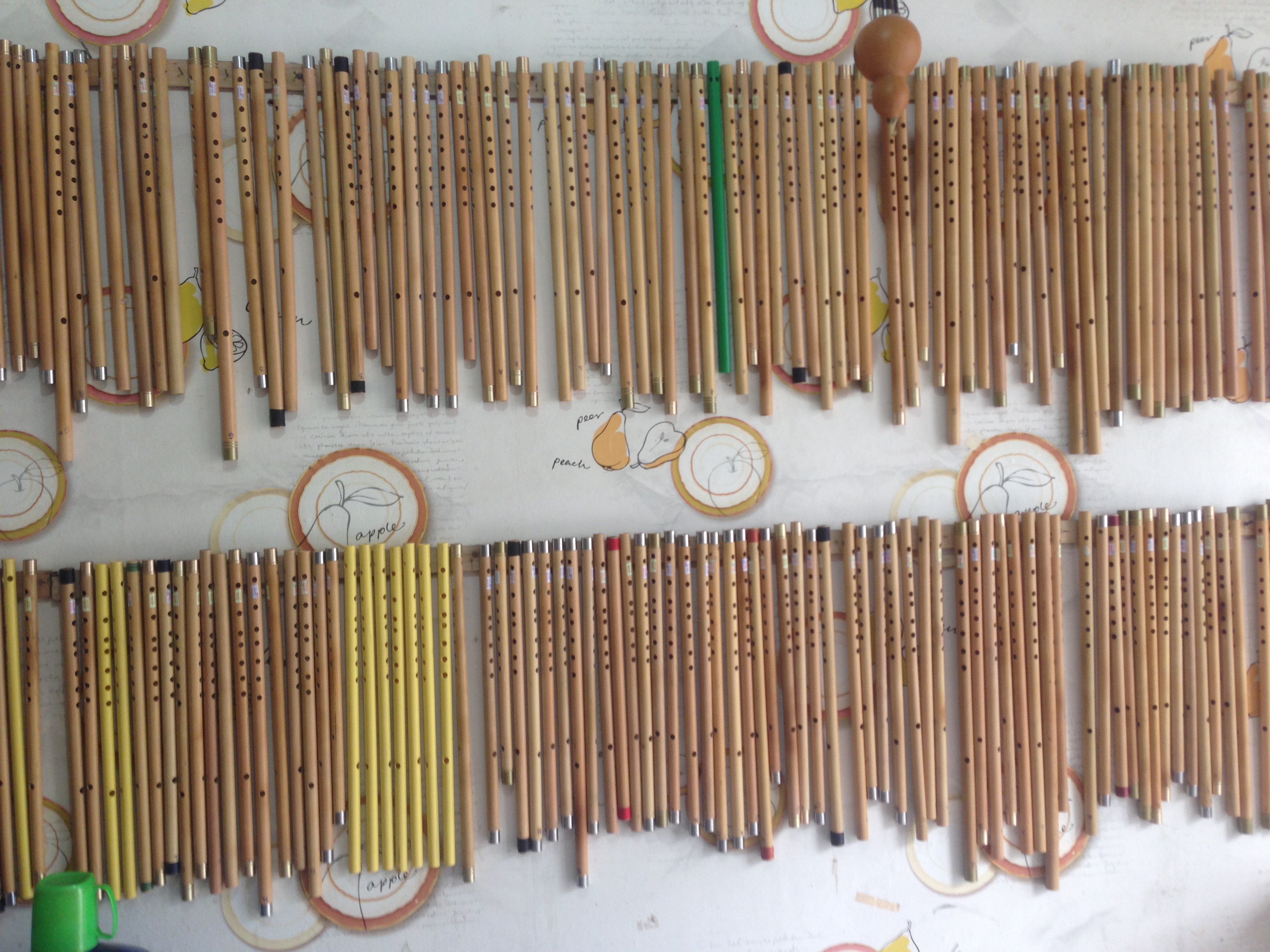 Mao Meo's flute store (Photo: Ha Ngan) |
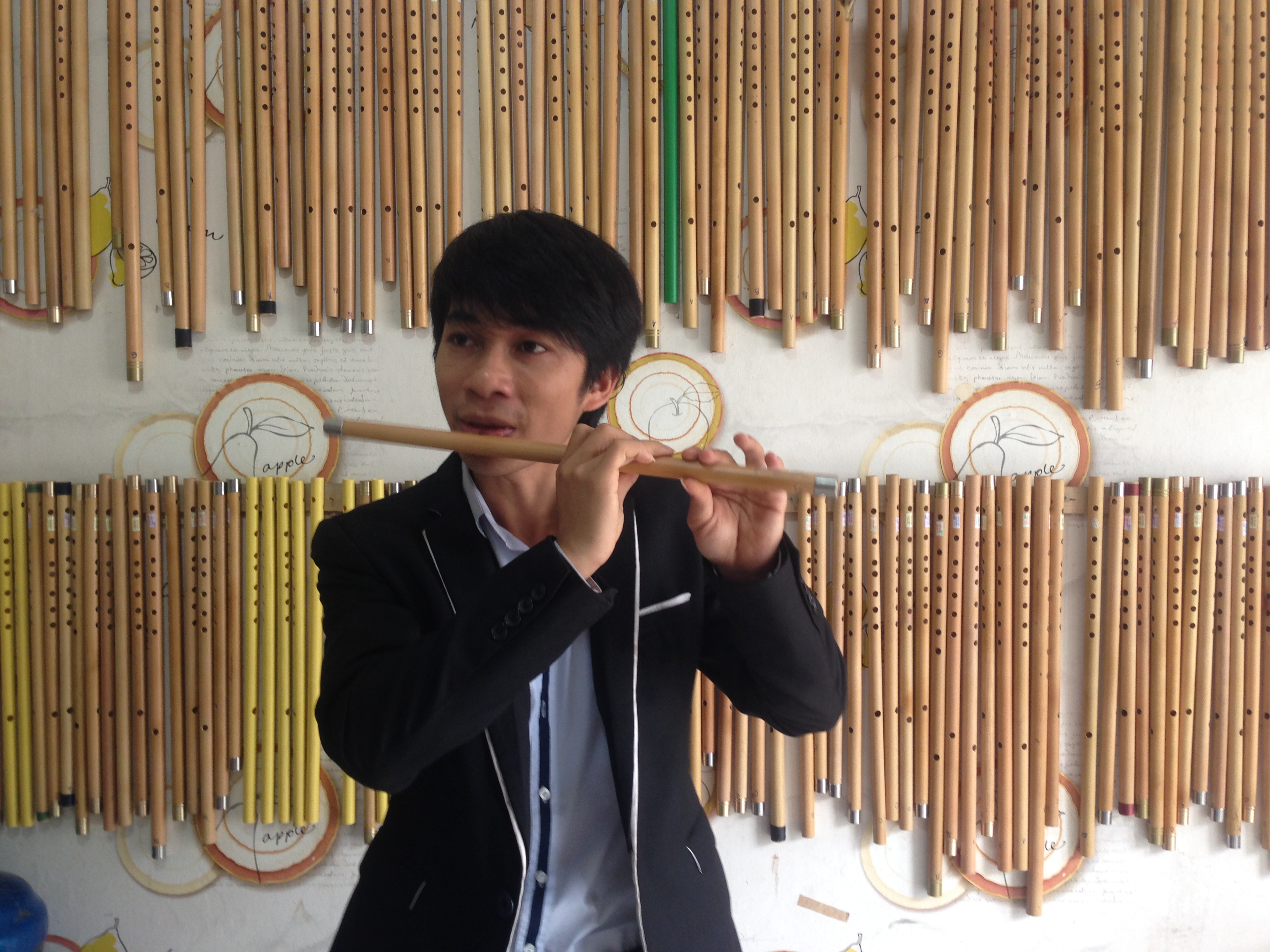 Flutist Mao Meo |
The Vietnamese bamboo flute is generally made from a single piece of bamboo, so, choosing the appropriate bamboo tube is the most crucial part of flute making. Flutist Mao Meo, who owns dozens of instrument stores in Vietnam, shared the process of selecting materials and manufacturing the flutes: “the most difficult part is to find areas with high-quality bamboo. Bamboo can be found in many places in Vietnam, but our stores often use bamboo from Lam Dong province. 3 to 5-year-old bamboo is the most appropriate material. Bamboo tubes with a suitable diameter are cut down and dried by the sun for a day. Then, they are boiled to kill termites and dried again until the bamboo tubes become tough and turn yellow. After that, sandpaper is used to polish the bamboo tube’s surface. Curved bamboo tubes need heat to be reshaped into straight tubes.”
A bamboo flute’s length varies from 40 to 55 centimeters. It measures just around 1.5 to 2 cm in diameter. The flute’s thickness is among the key elements determining the timbre or ‘tone color’ it produces. Flutes with thick walls tend to have a darker sound quality, because it requires more force to vibrate the bamboo. Meanwhile, thin-walled flutes often produce a brighter sound.
The first finger hole is usually 12 centimeters away from the blow hole. Finger holes are located evenly, usually at a distance of 1 cm. Traditionally bamboo flutes had only 6 finger holes, all in line with the blow hole.
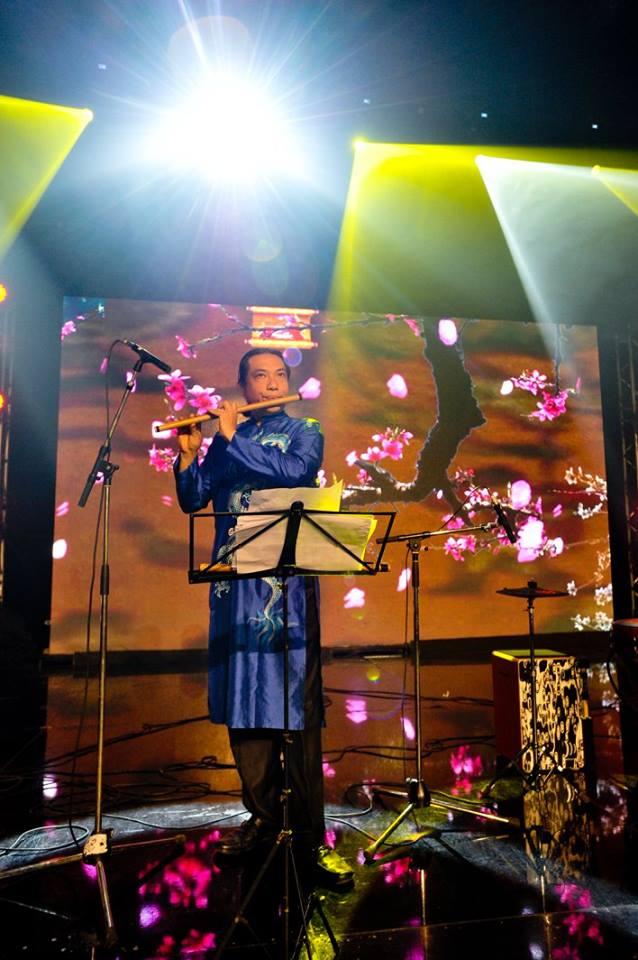 Flutist Nguyen Thang |
In the 1970s, well-known flute artist Dinh Thin introduced a ten finger-hole flute, with 4 additional holes located apart from the straight line of the main finger holes. Nguyen Thang explained the function of a ten finger-hole flute: “illustrious flute artists Dinh Thin and Ngoc Phan used the modified version of the bamboo flute quite early. 4 new finger holes are added to the original flute, so it takes all 10 fingers to play the instrument. As the register expands, players are able to produce more tones. The tonal palette and octaves the 10 finger-hole flute can produce are close to that of a Western flute.”
Inside the flute, a soft wooden piece is located near the oval blow hole to adjust the pitch. The air leaves the flute at the other end. The end-hole is often slightly smaller than the blowing hole, so that pitches can be discerned more easily.
In terms of the embouchure’s position, Vietnamese bamboo flutes can be categorized into 2 main types, including side-blown and end-blown flutes. Flutist Mao Meo distinguished the 2 types of flute:“the end-blown flute is played vertically, by blowing into a hole on the end of the tube. The side-blown or transverse flute is played horizontally. The sound volume that an end-blown flute produces is lower than that of a transverse flute. Practicing with a transverse flute helps to improve fingering skills, more so than an end-blown flute. If you are familiar with playing an end-blown flute, it will be difficult to learn to play the transverse flute later.”
It is relatively simple to acquire basic techniques to play the flute. 3 primary techniques are related to breathe control, embouchure control, and adjustment of the tube length, which determine the pitch, volume, and timbre of a note. However, it may take years of diligent practice to produce a smooth and full sound from this instrument.
Since the early days of Vietnamese orchestras, the bamboo flute has been one of the essential instruments played in Cheo (popular theater), Cai Luong (reformed theater), and Chau Van (ceremonial singing). Tuan Dung, a flutist working at the Voice of Vietnam Theatre with many years of experience playing the flute commented on the role of bamboo flutes in a traditional orchestra: “in traditional Vietnamese orchestra, the bamboo flute is one of the most essential musical instruments. The drum, the bamboo flute, and the two-chord fiddle are the three must-have instruments. They produce the main sounds that form the melody of the song.”
The Vietnamese bamboo flute is also favored for its ability to mimic natural sounds. Flutist Tuan Dung described this ability: “with a bamboo flute, flutists can reproduce the aural environment of the forest or the countryside. For example, in ‘Free wing’, listeners can feel like they are lost in a forest full of bamboo, streams, and different kinds of birds thanks to the imitating ability of the Vietnamese bamboo flute.”
The bamboo flute is not only used in Vietnam traditional music, but also in modern music. It can replace the Western flute with its amazing sound production.
Flutist Nguyen Thang shared some tips in choosing an appropriate bamboo flute to perform in modern music: “first and foremost, flutists should use a ten finger-hole flute instead of a six finger-hole flute. If we play a six finger-hole flute, we will have to apply the technique of closing the holes half way to produce half tones. Hence, the tones created might not be accurate. Secondly, artists should have flutes with different tones because unlike traditional Vietnamese music, substantial parts of modern pieces are composed with tone changing.”
The Vietnamese bamboo flute has recently been played in ensembles with electronic dance music (EDM) and received positive feedback from young audiences and listeners. This proves the vitality of this type of flute, since it has gone beyond traditional music to be played in the trendiest music, like EDM.
You’ve been listening to the song ‘Calligraphy’ on VOV. This week, we’ve been talking about the Vietnamese bamboo flute. We welcome your feedback at: English section, Overseas Service, Radio Voice of Vietnam, 45 Ba Trieu Street, Hanoi, Vietnam. Or you can email us at: englishsection@vov.org.vn. Tune in to our English program on the Internet at vovworld.vn. Good bye. See you next time.
