





 Vietnamese
 中文
中文
 日本語
日本語
 한국어
한국어
 Français
 Русский
 Deutsch
 Español
 Bahasa Indonesia
 ไทย
ไทย
 ພາສາລາວ
 ខ្មែរ
ខ្មែរ


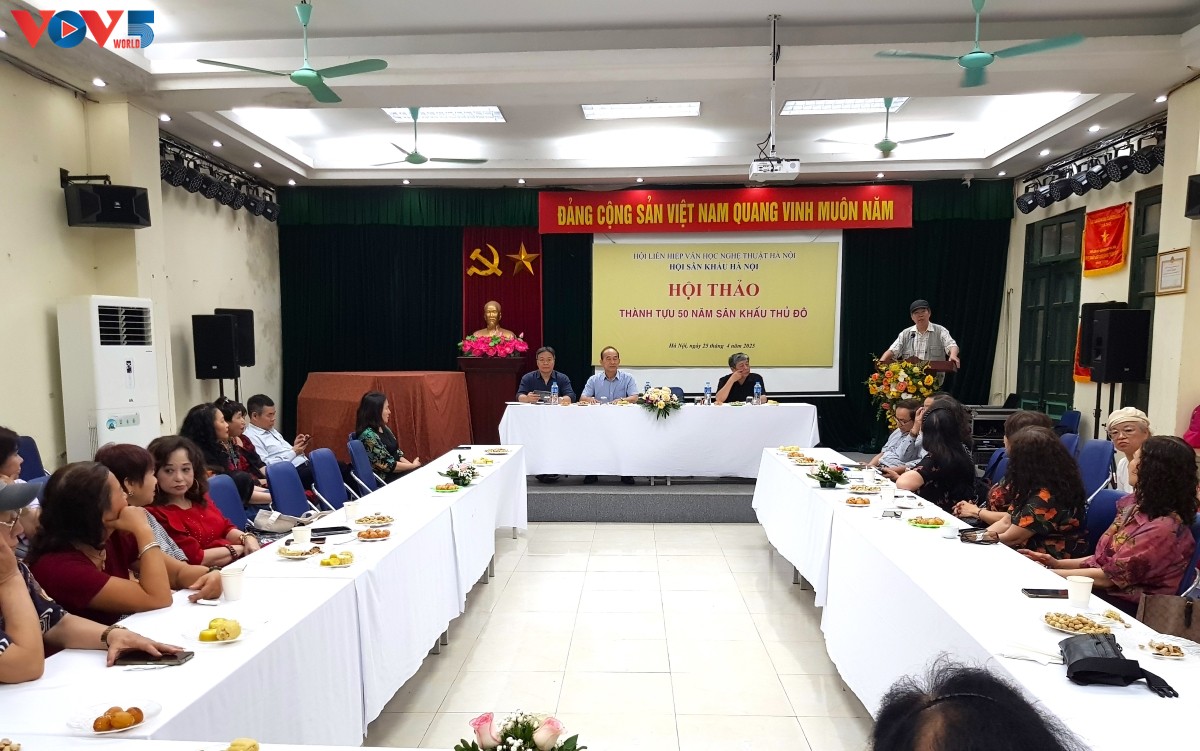 A workshop is held on April 25, 2025, to review 50 years of Hanoi’s stage art. (Photo: Ngoc Anh/VOV5) A workshop is held on April 25, 2025, to review 50 years of Hanoi’s stage art. (Photo: Ngoc Anh/VOV5) |
The 50-year journey of the capital’s stage art can be divided into two distinct periods. During first period, from 1975 to 1985, spoken drama flourished, with notable plays like “The Soul of Truong Ba in a Butcher’s Body”, “Me and Us”, and “The Ninth Oath” by playwright Luu Quang Vu, as well as “Vietnam, My Homeland”, “Tomorrow’s Weather”, and “Summer by the Sea” by playwright Xuan Trinh.
The second period began with the Doi Moi (Renewal) era in 1986, ushering in a wave of innovation in Vietnamese theater.
“National reunification created a blending of the stage art of the North and the South. In 1986, with the launch of Doi Moi, the theater scene underwent significant changes, directly addressing social issues. Playwright Luu Quang Vu became a phenomenon of this era, with ‘Me and Us’. From 1996, as Vietnam entered a market economy, the stage art took on a fresh look. This period saw the emergence of creative camps for writers, which were enthusiastically embraced,” playwright Le Quy Hien said.
The theatrical works of Hanoi’s stage art have deeply reflected social life and strongly influenced the public, achieving resounding success with major plays like “Forever Seventeen”, “The Last Lie”, “Me and Us” by the Vietnam National Drama Theatre, “Sita” by the Hanoi Cheo Theatre, and “The Scholar” by the Hanoi Reformed Opera Theatre.
People’s Artist Bui Thanh Tram, former head of the Vietnam Stage Artists Association, said that Hanoi has been a gathering place for many renowned playwrights and famous stage directors. “Many veteran artists have been the pillars of Vietnamese theater. Today, some of them continue their creative pursuits with passion, while the younger generation has actively renovated and brought fresh development to Vietnam’s art scene in the era of international integration.”
People’s Artist Nguyen Trung Hieu, Director of the Hanoi Drama Theatre, said, “In recent years, we have brought drama into schools, integrating it with literary works and historical figures in the school curriculum to introduce the stage art to students, who will be the audience of contemporary stage art.”
Over the past 50 years, Hanoi’s stage art has produced many great names. People’s Artist Nguyen Hoang Tuan, Chairman of the Hanoi Stage Artists Association, said Hanoi’s stage art has covered every major political and cultural event of the capital and the nation.
“Among the members of the Hanoi Stage Artists Association, two have been awarded the Ho Chi Minh Prize, and 24 have received the State Prize for literature and arts. Many other members have been awarded prizes from the Vietnam Union of Literary and Arts Associations and other professional associations,” said Tuan.
Critics, theorists, poets, and writers in Hanoi have played an important role in shaping the identity and improving the quality of the capital’s stage art over the past decades.
“The capital’s stage has covered Cheo (Vietnamese traditional opera), Tuong (classical drama), water puppetry, and spoken drama. It has continuously innovated, blending genres, content, forms, and performing styles, and training generations of performers. It continues to foster and nurture the values of humanism, patriotism, and the nation’s cultural heritage, meeting the demand of local audience’s spiritual life,” said writer Nguyen Thi Van Kim.
