





 Vietnamese
 中文
中文
 日本語
日本語
 한국어
한국어
 Français
 Русский
 Deutsch
 Español
 Bahasa Indonesia
 ไทย
ไทย
 ພາສາລາວ
 ខ្មែរ
ខ្មែរ


(VOVworld) – The Cham villages are located on the high land surrounded by farm land. Every clan or large household lives in houses in the shape of a rectangle or a square. Houses are built in accordance with a certain process.
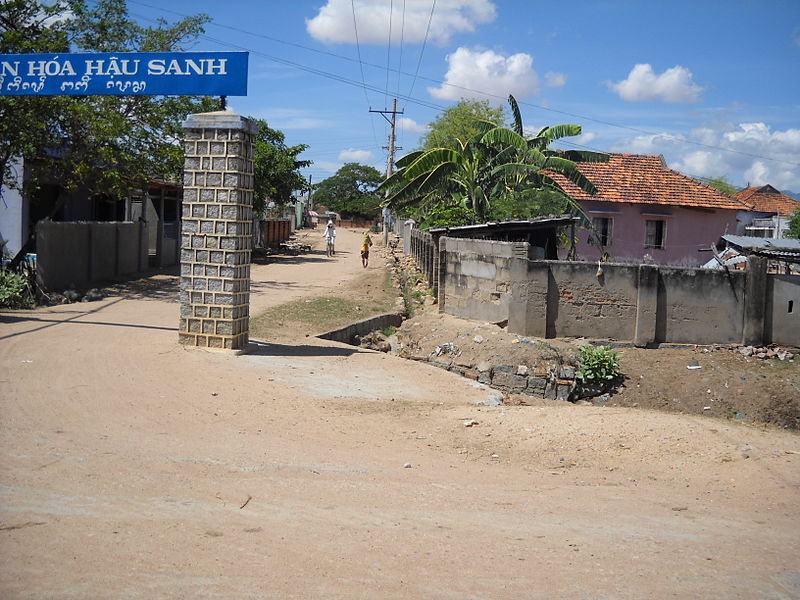 |
| A Cham village in Ninh Thuan (Photo: wikipedia) |
The Cham people do not grow high trees which they think are the shelters of monsters, thus, the Cham villages have few trees. A series of houses stand next to each other in the middle of parallel or perpendicular pathways. Doctor Le Duy Dai from the Vietnam Museum of Ethnology said: “Normally, the Cham houses face the East. In a Cham village, houses are nicely arranged like streets with alleyways. Village pathways are built in North-South or East-West directions. That’s why the Cham houses or houses of a clan are built in a straight line".
In the Cham’s matriarchal family, every couple of sisters has their own house. So the number of houses in a plot of land depends on how many married women that family has and on which class that family belongs to. Doctor Le Duy Dai told VOV:“The aristocrats usually have 7 houses sitting next to each other, while the poor have only 5 houses altogether. The extra two houses of the aristocrats are used to accommodate farming tools such as mandrels and shovels and household appliances such as grinders and rice-hulling mills”.
The most important house among them is called Thang dơ, where family rituals take place like wedding and ancestor worshipping ceremonies.
 |
| A Cham house in the Vietnam Museum of Ethnology (Photo: wikipedia) |
The Cham people choose the direction of the houses for particular reasons:
Today, the Cham’s matriarchal system is changing into nucleus families. The number of houses is reduced and the interior decoration is paid less attention. But the “soul” of each house remains:
New and modern houses are emerging in a Cham village. But the building method remains traditional. The days to start construction work should be Wednesdays and Thursdays, which are the even days of the last weeks of March, June, August, October and November in accordance with the Cham calendar.
